01 / ORIENTATIONREAD THE CAMP
A whole world.
Three people to look after.
Your camp lives on one screen. Learn where to look, and the next decision gets much easier.
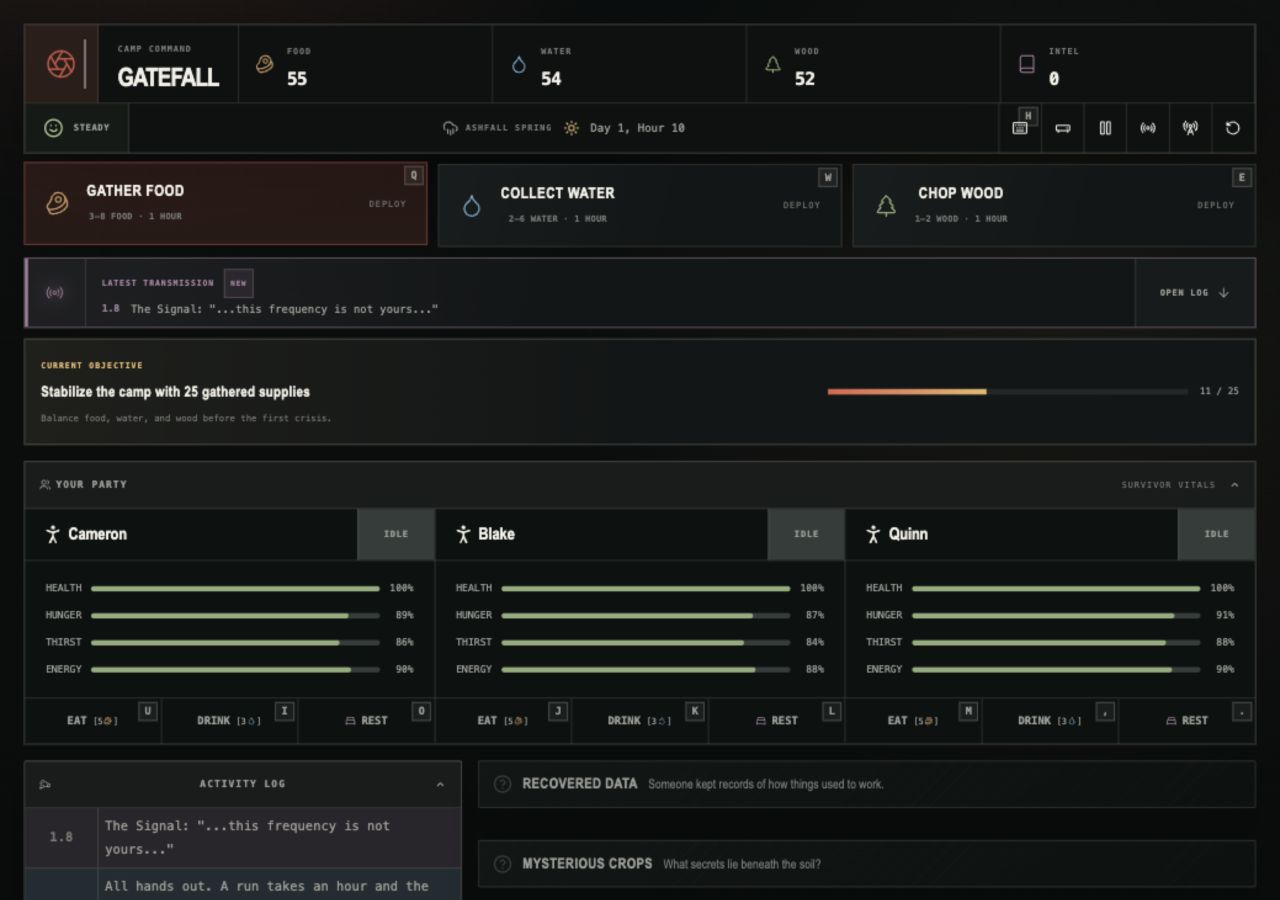
Your stores
Shared food, water and wood. A full store does not mean your people have eaten.
Your orders
Choose a resource. The available survivor with the most energy takes the job.
Your people
Read all four bars. Use Eat, Drink and Rest between orders to keep needs from reaching zero.
One game hour normally takes four seconds.
One full day = 96 seconds.
On days 1–3, the next hour can take just two seconds when everyone is busy or resting. The clock pauses in a hidden tab and during game dialogs; there is no offline catch-up.
02 / FIRST CONTACTSTART HERE
Make the first day count.
Start on Outpost. Fifty food, fifty water and fifty wood give you room to learn. Your first objective is a repeatable routine.
Choosing a harder start
Difficulty changes starting supplies. Base gathering rules, need decay and upgrade prices stay the same.
| Start | Food | Water | Wood |
|---|---|---|---|
| Outpost | 50 | 50 | 50 |
| Wreckage | 25 | 25 | 25 |
| Ground Zero | 0 | 0 | 0 |
03 / LOGISTICSEVERY HAUL HAS A COST
Three things worth
going back out for.
Food buys another meal. Water keeps your crew moving. Wood turns a temporary shelter into a camp with a future.
Food
3–8 BASE YIELD
Your daily reserve. Keep meals in the store before paying for a new building.
Q GATHER FOOD
Water
2–6 BASE YIELD
Watch this closely. Thirst tends to drain faster than hunger, and water yields less.
W COLLECT WATER
Wood
1–2 BASE YIELD
The slow haul. Expensive in energy, essential for buildings and the winter fires.
E CHOP WOODThese are day-one base ranges. Age, tools, roles, season, weather, night and permanent bonuses change actual returns. Each order commits a survivor until the next game hour.
| Order | Hunger | Thirst | Energy |
|---|---|---|---|
| Gather food | −1 | −3 | −5 |
| Collect water | −3 | −1 | −4 |
| Chop wood | −4 | −4 | −6 |
The camp credits supplies and action costs when you issue the order; the survivor then becomes busy. Needs can fall again as the next hour resolves. Gathering does not replace food, water or rest.
04 / SURVIVOR CAREPEOPLE BEFORE PROGRESS
Look after the hands
that keep you alive.
A stocked camp can still lose someone. Supplies in storage and a survivor’s needs are separate things.
Eat and Drink are instant, but only available while that survivor is free. Feed and water them before Rest or another order.
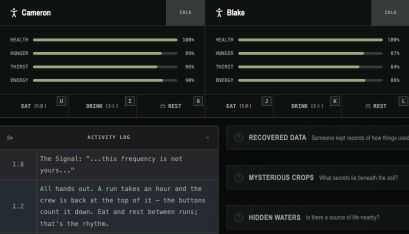
Eat
5 food → 25 hungerAround 70–75 hunger is a useful reminder to eat without wasting much of the refill.
Drink
3 water → 25 thirstWatch each person. Their thirst rates differ; one may need water before the others.
Rest
25 energy / game hourRest ends at full energy. Hunger and thirst still drain, at one-fifth of their normal rate.
With hunger, thirst and energy all above 50, a survivor slowly recovers health. A well-fed, well-watered resting survivor heals faster. If someone dies, they stay dead for that run; the camp continues until nobody is left.
05 / ESTABLISH THE CAMPBUILD SOME BREATHING ROOM
From getting by
to putting down roots.
A good building gives something back. Start with a food-and-water foundation, then improve the tools and stores that support it.
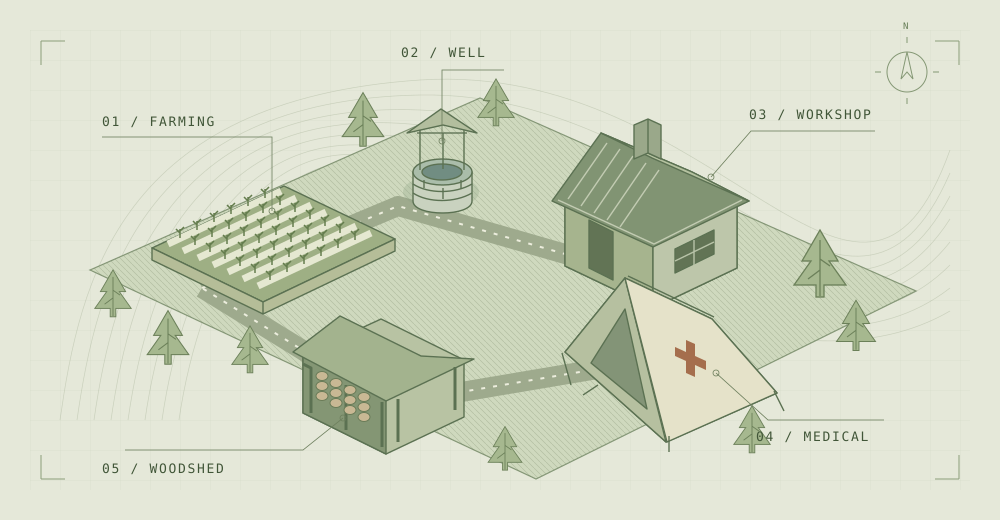
- 0180 FOOD
Farming
Unlocks 25 crop plots. Start small: one wheat plot costs 5 water, grows for 24 game hours and yields 20 food before upgrades. Plant, wait, then harvest.
- 0280 WOOD
The Well
Requires Farming. Fills its own reservoir at 1 water per game hour, up to 100. Use its Collect Water button to move that water into camp stores.
- 03400 WOOD
Tool Workshop
Raises gathering efficiency by 25%, with rounding in the yield ranges. Save for it once you can spare wood without neglecting food, water or care.
- 04200 FOOD
Medical Tent
Heals living survivors over time. Move this ahead of the workshop if injuries are making the camp fragile.
150 WOOD - 05SEE BELOW
Room for a reserve
Buy storage before overflow wastes a haul. A Woodshed gives you room to stockpile for winter.
600 → 1,500
150 wood + 100 food400 → 1,000
150 wood + 100 water600 → 1,500
200 woodBase prices before building discounts. Resources above storage capacity are discarded. This order is a starting plan: respond to an injured survivor or a dwindling store before saving for the next upgrade.
06 / THE LONG WATCHAN 80-DAY YEAR
Winter is coming.
Prepare while it isn’t.
Each season lasts twenty days. The generous weeks are your chance to prepare for the difficult ones.
Ashfall Spring
+10% water
+5% food
Dig the well.
Scorch
−15% water
+10% wood
Keep building.
Graywind Autumn
+15% food
−5% water
Stack the wood.
Static Winter
−20% food
−10% water
Keep the crew warm.
Seasonal gathering modifiers, before weather and other bonuses. Winter also gives +5% knowledge. The cycle returns to spring on day 81.
Keep something
between them
and the cold.
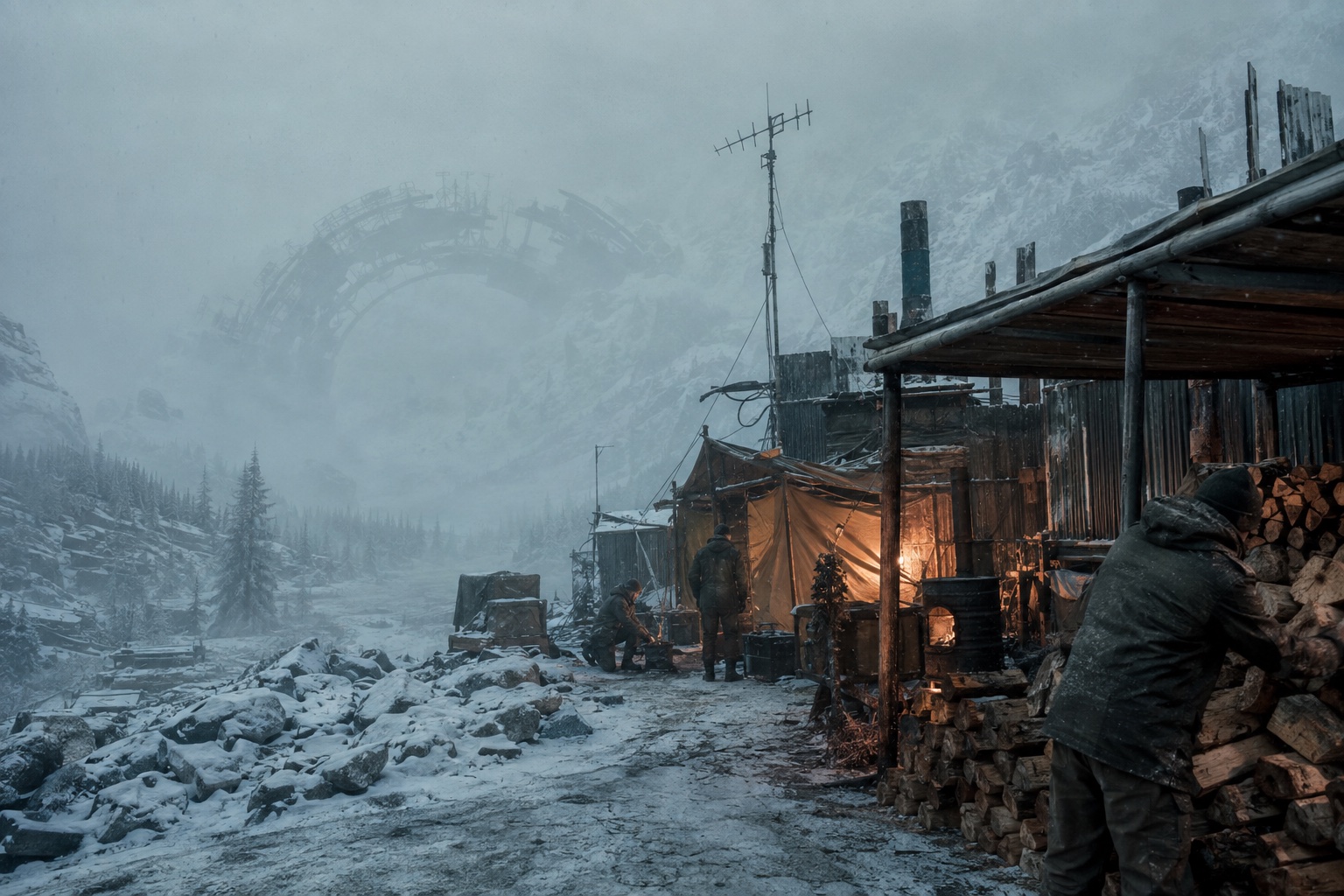
The fires burn one wood each game hour through winter. When the wood runs out, every living survivor loses 3 energy per hour to cold. A 480-wood reserve covers the fires for twenty days, but leave extra for building and setbacks.
07 / THE FAR ROADSTAKE ONLY THE RISKS YOU CAN CARRY
There is more
beyond the fence.
Expeditions unlock from day three. One runner can leave at a time. Start close to home, with someone healthy enough to come back.
Collapsed Suburbs
Food and water. The shortest commitment and a sensible first expedition.
Machine Graveyard
Wood and intel. A longer absence for supplies that can move the camp forward.
The Gate Scar
A larger potential haul and bonus fragments. Prepare for injuries and a long wait.
Choices and setbacks can change the outcome; the reward is never a promise. Keep enough supplies for the people left behind, and allow extra time for storms.
Give your survivors a specialty
Specialization Training costs 250 food, 150 wood and 5 intel. It unlocks changeable roles. Gathering has a 5% chance to find knowledge, with bonuses able to change the amount.
- Gatherer
- 25% more from gathering. A useful first role.
- Builder
- A living Builder reduces building wood costs by 20% for the camp.
- Researcher
- Generates 0.5 base knowledge per game hour.
- Fighter
- Reduces expedition setback chance by 10 percentage points and injury by 25%.
- Medic
- A living Medic makes the Medical Tent 30% more effective.
08 / THE NEXT TOMORROWSOMETHING ALWAYS REMAINS
A camp can fall.
Its story carries on.
Memory fragments outlast a run. They turn what this camp learned into a better chance for the next one.
This is the incremental half of the game, and the reason permadeath is survivable. Nothing about a dead camp is recoverable — no earlier day to reload — but the fragments it banked buy permanent upgrades that every camp after it starts with. It is not an idle game, though: the clock only moves while the tab is in front of you, so a camp left overnight is exactly where you left it.
From day ten, Broadcast Memories lets you end the run voluntarily. You bank fragments for the day reached, researched technologies and every survivor still alive. A wipe also banks fragments, but without the living-survivor bonus.
22 for the day reached + 9 for the crew
Broadcast when the next few days look more dangerous than rewarding. Waiting longer can earn more; it can also cost the people who make the bonus possible.
Scavenger Instinct
Gathering yield per level
Cached Supplies
Each starting resource per level
Hardened Survivors
Maximum health per level
Signal Discipline
Intel gain per level
Each upgrade has five levels, costing 10, 20, 40, 80 and 160 fragments. Awards use ⌊day1.15⌋ + 5 × researched technologies + 3 × living survivors. These memories are stored in this browser; clearing site data removes local progress.
TEAR-OUT REFERENCEKEEP WITH YOUR FIELD NOTES
When things go sideways.
- No one can gather.
- Everyone may be busy or resting. Check the countdown and return to care when someone becomes available.
- The stores are full. Someone is hungry.
- Stored food is not automatically a meal in a new camp. Use that survivor’s Eat button between orders.
- I built a well. Where’s the water?
- Open the Well module and collect its reservoir. It fills separately from your camp’s water store.
- My hauls look smaller.
- Check the season, weather, night and camp mood. The displayed base range is modified by these effects.
- Energy is collapsing in winter.
- Check wood immediately. Empty fires cost everyone 3 energy per game hour. Then feed, water and rest the crew.
- I need time to think.
- Use the pause control. A hidden tab also pauses the clock, and the camp does not advance while closed.